
I say this often: Even a week’s hiatus can be detrimental to the practice of writing.
The good news is I have many projects on the horizon.
I have taken (with the approval of my father) a year to focus on my writing goals.
My hope is that my new manuscript of old short stories is accepted for publication. I have been going through a list of all of the available publishers in The Writer’s Market 100th Edition. I have also sent out a proposal to an agent, and will be looking through the list of agents in the book as well.
It is time that I publish in literary magazines and contests. Hopefully this will give me some credibility.
I do well with lists.
Write books and short stories
Submit to literary magazines
Find an agent
Get published
If I make a list of things I want to accomplish, in some way or other it usually is done. Sometimes, there are new things that become prioritized, and old things linger on there for years.
“Business as usual against the heart.”
For example, I’ve wanted to write a certain book since I was 18 years old. This year, I decided I had three other books to write that would take precedence. Last week, a novel called to me to be written, and I am six chapters into that.
A change of plans can be a good thing. I hope I will be able to write my first book idea better with the extra practice. It seems so.
The good news is, I have an academic year ahead of me to accomplish all of these goals.
But I should keep a list of my duties. And a daily agenda to make sure that I am given the space to accomplish these things. And enough humanity to throw my agenda out the window every once and a while.
I will be your friendly-neighborhood-substitute teacher again this year. I am so happy about it. Hopefully, it either leads to a future job or future stories.
I have gained some weight. I will have to be wise about my diet, exercise, sleep schedule, and other indulgences to make sure that I am of sound body and mind.
I wonder if I have lost my great, in-depth analysis of everything; well, hopefully we won’t have to wait until next week to find out.
The Broom of the System by David Foster Wallace – Book Review/Synopsis
The Broom of the System was David Foster Wallace’s first novel. It was written in 1987 during a sabbatical he referred to as a quarter-life crisis while he was still attending Amherst.
It was published when he was 24.
The idea for the book came from his ex-girlfriend’s comment,” She would rather be a character in a piece of fiction than a real person.” The book follows a girl named Lenore Beadsman, who is having an existential crisis because she cannot tell if she is a real person or just someone who exists within the confines of a book. By the end of the book, the reader will have trouble distinguishing between this fact or fiction.
My copy is approximately 467 pages, and much ground is covered. The plot, to put it briefly, is about a telephone operator who is the heir of a baby food company whose grandmother has escaped from a nursing home. Everyone she meets is, for some reason, infatuated with her. The opening chapter is about Lenore visiting her sister at Amherst, where a group of Fraternity brothers, one of which is Wang-Dang Lang, come in and force the girls to sign their asses.
She is in a committed relationship with Rick Vigorous. However, Rick meets Wang-Dang Lang at a bar while Rick and Lenore are visiting Amherst – in which Lenore sees her brother La Vanche – and Rick invites Wang-Dang to come to work for him after learning that he is married to a girl that lived across the street from Rick when he was young and who he is still infatuated with. And then things go awry.
The book’s primary narrator and other existential crises comes from Rick Vigorous, an overly anxious and dependent president of a publishing house called Frequent and Vigorous. I wouldn’t categorize him as an unreliable narrator because almost everything he says aloud in the book is said in a manic, oversharing way that you can’t help but believe or must deny. However, make no mistake; he is a scheming shyster who is entirely discredited by the end of the story.
You sort of love to hate him the way a friend of yours whines about every single thought that comes to his mind without the ability to censor his indiscretions and insecurities. Although Rick is never vulgar, just pious in a very pathetic way.
While Lenore, on the other hand, you only want to hear more of what she thinks while the rest of the characters smother her. Wallace claims that the character of Lenore was his autobiographical portion of the book, but I can’t imagine it being an autobiographical novel; it is just too ridiculous.
Another memorable character is Vlad the Impaler, a Cockatiel that ate some cutting-edge baby food, which made him start religiously preaching, interspersed with echoes of Lenore’s roommate’s breakup.
Bombardi is a man who tries to eat so much that he will take up all the space in the universe.
La Vanche, Lenore’s one-legged drug-addicted philosopher brother, also referred to as the Anti-Christ, will give you flashbacks of all the egomaniac first-year college students we all knew.
Wallace renounced the book, saying that a very clever 14-year-old could’ve written it, and I and other critics couldn’t disagree more. Aside from the fact that it is very clever, there is no doubt that there was a lot of conscientious writing by someone who was grappling with himself, but also the world around him.
A fault of the book is that it was written by a 24-year-old, so some convictions about the world are a tad cynical and one or two unoriginal paragraphs, but it is so rare that it is barely worth mentioning. The book is profoundly original, in my opinion. That being said, Wallace was criticized, saying that it ripped off The Crying of Lot 49 by Thomas Pynchon – a book that also follows a woman who everyone is trying to seduce – caught in a conspiracy. In Wallace’s defense, he claims he hadn’t read the novel when he wrote Boom of the System, but there are more similarities beyond just the plot. The language is suspiciously similar, but great thinkers think alike.
But that is what makes this book so unique: it does not conform to many rules of what is supposed to be a book. While on a radio interview, someone called in and said, “I’ve never read anything like it.” I can say the same. I have read many books, but reading this, as a writer, has really broadened my idea of what an author can do with a text.
It intermingles with places that exist and things that don’t. One of the many, many plot points is about the Great Ohio Desert, Abbreviated as G.O.D. in the book. Now, you and I know there is no such thing as the Great Ohio Desert, but Wallace is toying with the extent to which business moguls could infiltrate suburban living for profit.
The book is written mostly and plays with many forms of dialogue: Transcripts, short stories interwoven inside the book, and no reference to who is talking. This keeps it fresh because you never know exactly what will be in store for the next five or ten pages within chapter breaks referred to as /a /b /c etc.
The plot is a bit messy, but you really don’t care, and readers should be able to find a common thread throughout the story for the most part. However, this would be one of my critiques of the novel. It seems to be reaching from too many wells; the thread is loose, and many of them are not tied up.
However, if the author was aware of this school of thought that the storyline meanders, it satirizes itself by the end of part one, where at a bar, the male lead, Rick Vigorous, meets an acquaintance named Wang-Dang Lang in one of those small world happenstances that ties us in the invisible lines that connect us all, even if it seems stranger than fiction.
Although it was written in 1987, it is technically a futuristic novel, as is Wallace’s much more famous work, Infinite Jest. This is an unpopular opinion, but based on these two premises of these stories, David Foster Wallace could be categorized as a science-fiction writer because both books exist in a near dystopian future.
The book toys around with sexual innuendo constantly, as any 24-year-old writer would do. But I think if there is a moral to the story, apart from a few philosophical mindfucks, it is that sex is not the most important part of a relationship; it is about the ability to connect with the person you are in bed with.
Lenore and Rick Vigorous spend many nights in bed, with Rick talking – telling Lenore stories that Lenore enjoys. However, at the end of the novel, Lenore is in Bed with Wang-Dang Lang, and he tells her a story that makes her cry for the first time in her life.
I would highly recommend this book. Like Pynchon’s language, once you grasp the style, you will fall in love with it, and it becomes much more accessible. I hope you give this book a chance. I think it is a great place to start with Wallace’s fiction, and I look forward to reading his second book Girl With Curious Hair.
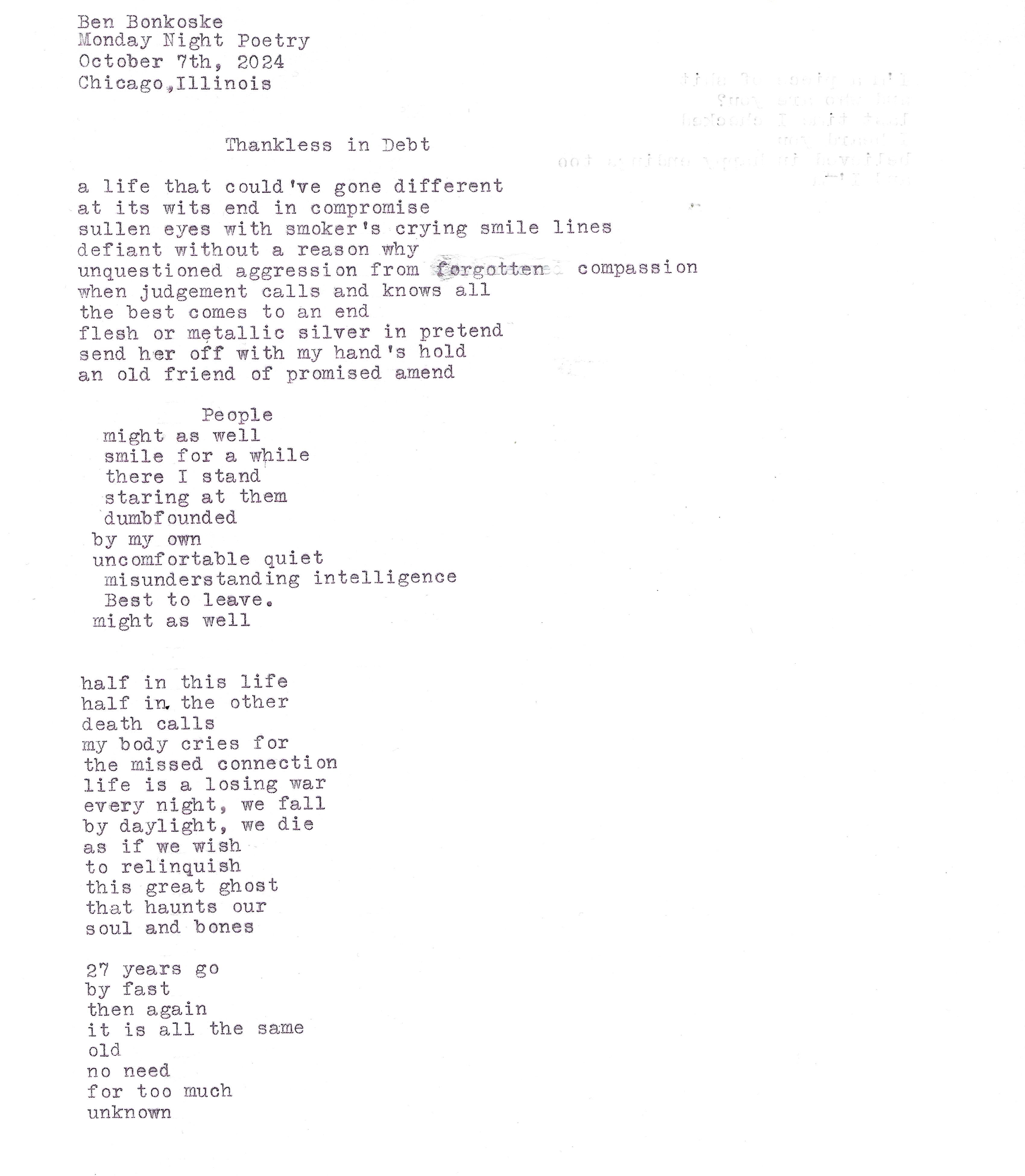
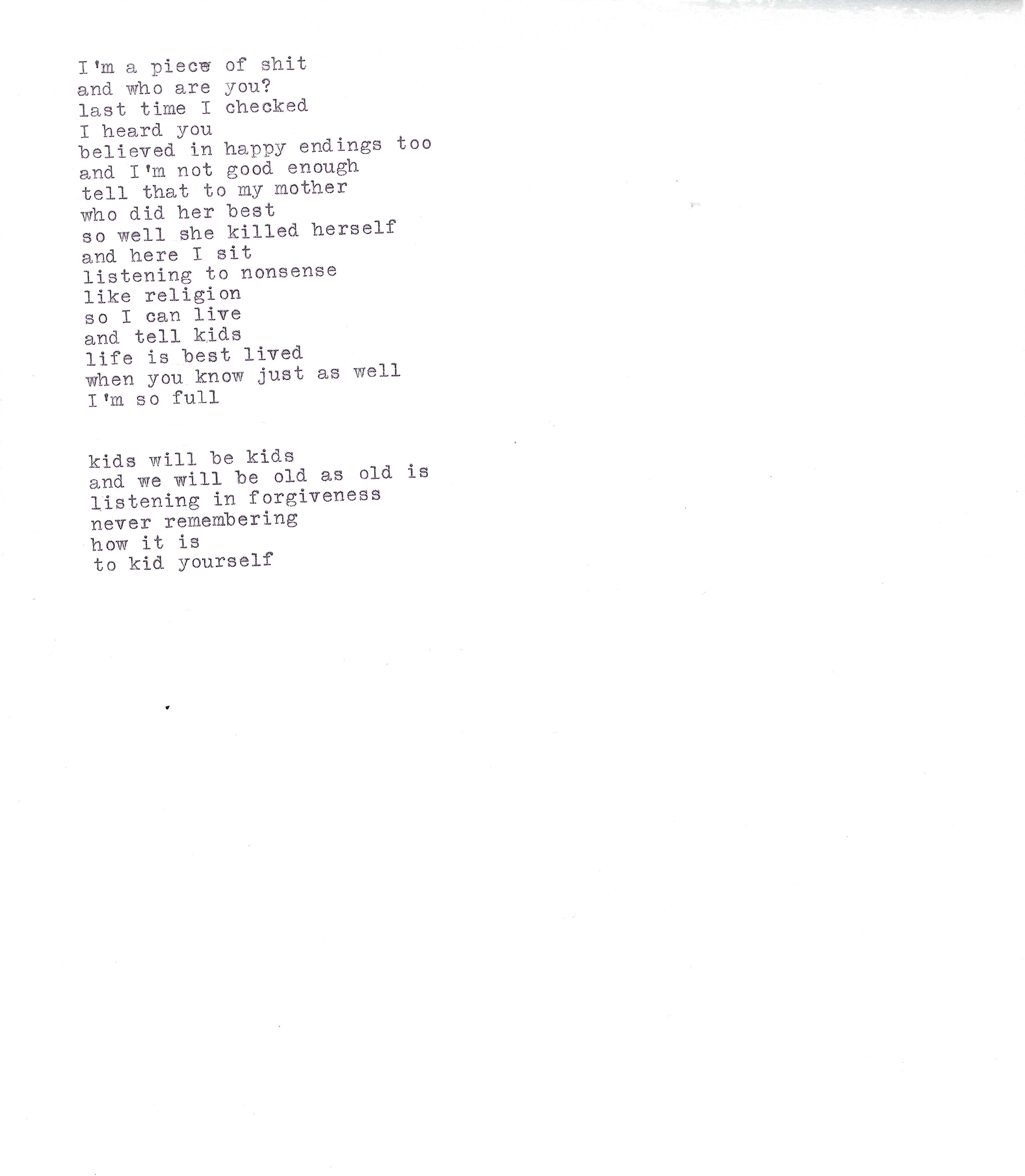
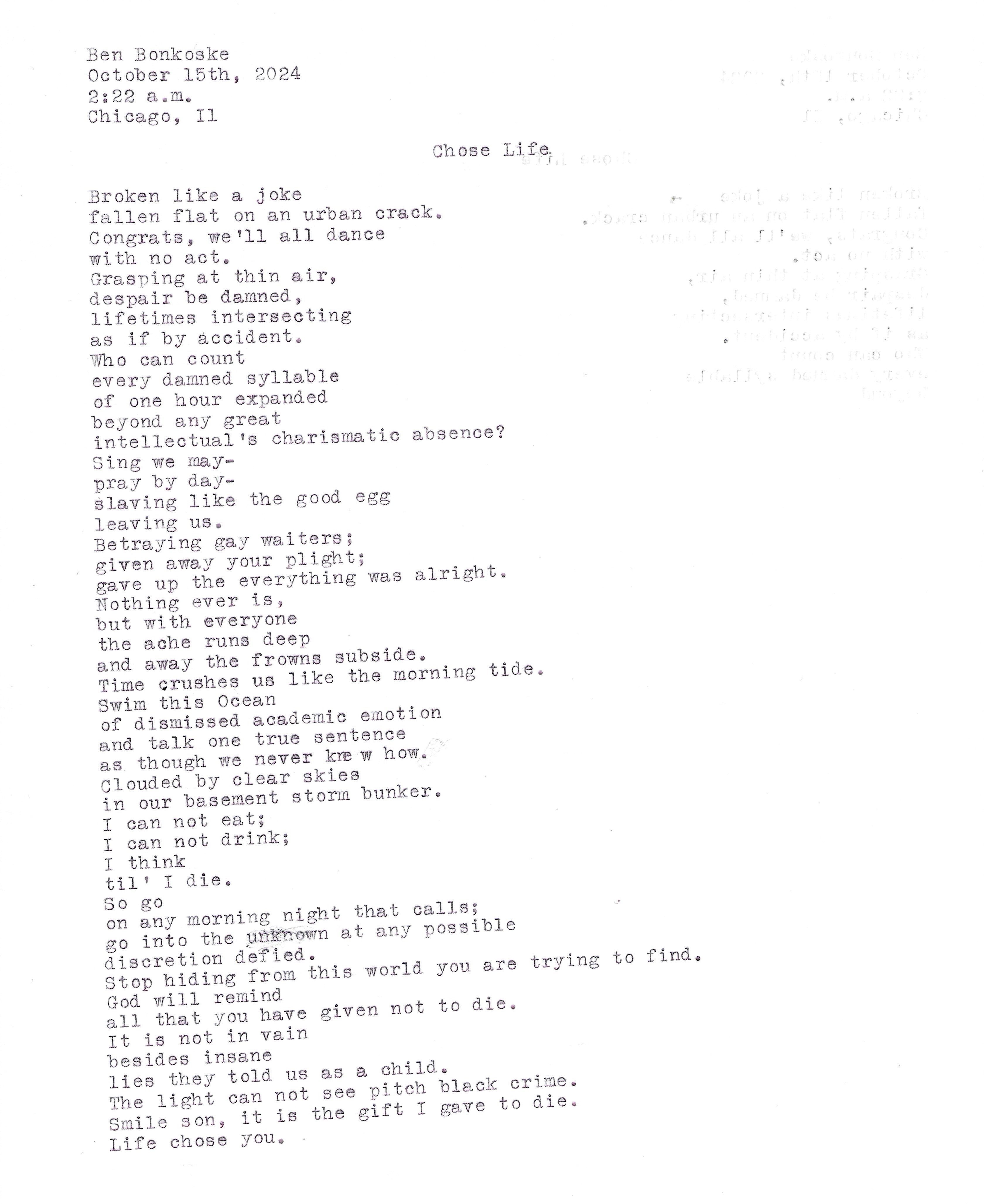
As an old folk song sings to my ears, I hear remembrances from the passing of a time unsolved. We wait too long and look too often into others for answers unknown to all but us. I relax my elongated crooked spine, ready to uncover a word or two about the world inside me. Perfection is only a discretion.
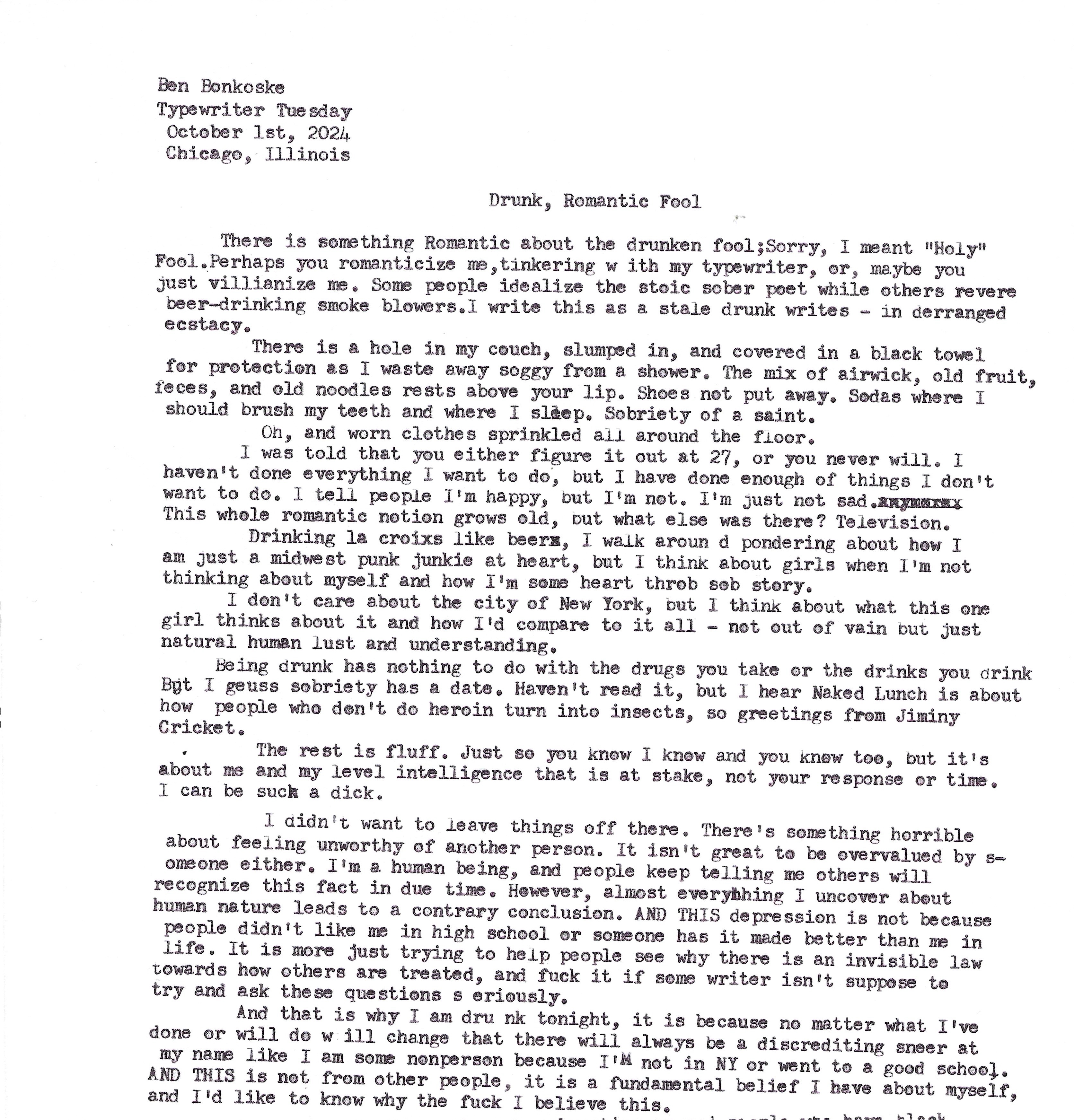
To write pretentiously is nourishing to the soul and fingers. However, can you imagine how annoying a person would be if they only spoke that way? “The evening brings upon a mood of unjust solitude within the den of my caricature.” Ok, buddy…
There are writers, such as Jonathan Franzen and Thomas Pynchon, who write novels in that pretentious way. Some of them are quite good, so I’ve been told. Just because you write something complicated does not mean you are smarter than anyone. It might suggest you are insecure of your intelligence and get off on making others feel unavailable to your ideas.
Speaking of opinions, it has been a while since I’ve written much of a update.
My entire American life has been based on the notion of working hard to never be good enough. Oh, and mixed in with symbolic delusional pyschosis.
Yes, yes, it is true, I’ve become a normal rational individual. I no longer am building bigger realities about every detail into something beyond belief.
It’s weird to be back on planet earth (4 months now), and who knows how many of my invisible line laws were based in truth or on self-deception.
I think one of the hardest part of coming back from the war with myself is seeing others still fighting, lost within themselves.
I’m learning that what I do is less important than how and why I do it. If I’m a janitor, I’d better be the best damned janitor to support my love of the opera.
This isn’t an exclamation, it is a explanation that I’m so glad I found myself; the kid I once knew. Now, let’s try and grow.
Ben Bonkoske is the author of two novels, Spoon in the Road, and Carolina, Colorado, California. He is also the author of two collections of short stories, Ten Zen by Ben, and Eleven Stories for 11:11. He lives in Chicago, where he likes to take walks.